Welded vs Stitched Seams. Why Construction Matters in Waterproof Gear

Take two backpacks made from exactly the same waterproof material.
One can keep water out.
The other can leak.
The difference may have nothing to do with the fabric.
It can come down to how the pieces of that fabric were joined together.
At KiffLab, this is one of the details we pay a lot of attention to. Our waterproof packs use welded seams because a waterproof material only gets you so far. Once you start cutting it into panels and building a bag, every seam becomes part of the waterproof system.
And there is a fundamental difference between stitching two pieces together and welding them together.
Waterproof fabric does not automatically mean a waterproof bag
This is probably the biggest misconception around waterproof gear.
A manufacturer can use a material that is completely impermeable to water and still produce a finished product that leaks.
Why?
Because a backpack is not one continuous sheet of material.
There is a front panel, back panel, base, sides, straps and attachment points. Those pieces need to be joined.
With conventional sewing, a needle repeatedly passes through the material and thread holds the two panels together.
That works extremely well for millions of products.
But it also creates holes.
Waterproof clothing manufacturers deal with exactly the same problem. Waterproof jackets are normally constructed using stitching and then waterproof seam tape is bonded over the stitching on the inside. The tape covers the needle holes that would otherwise provide potential routes for water.
So when you see terms such as fully taped seams, that additional step is important.
The fabric may stop the water.
The seam tape stops water entering through the construction.
For the type of waterproof packs we build at KiffLab, we take a different approach.
We weld the main waterproof panels together.

What is a welded seam?
A welded seam joins compatible thermoplastic materials using heat, energy and pressure rather than a conventional needle and thread.
With high-frequency welding, also known as HF or RF welding, electromagnetic energy causes molecules within compatible thermoplastic materials to move and generate heat.
The material softens where the two layers meet.
Pressure is applied.
The materials fuse together.
They are then allowed to cool while still under pressure, leaving the two panels permanently bonded.
Industrial HF welding typically operates at 27.12 MHz and is particularly well suited to materials including polyurethane, PU and thermoplastic polyurethane, TPU.
That matters to us because TPU is central to the waterproof construction of KiffLab products.
Our TuziGazi range uses heavy-duty 840D TPU material.
Our Amanzi takes a lighter approach using 420D ripstop nylon with a TPU waterproof coating.
Both use welded seam construction.
Welding and sewing solve the same problem differently
Imagine joining two waterproof sheets.
With stitching, you overlap or position the sheets and repeatedly push a needle through them.
The thread creates the mechanical connection.
With welding, the surfaces themselves are bonded together.
There is no continuous row of needle holes along the main welded seam.
That is the key difference.
It does not mean sewing is bad.
Far from it.
A properly designed stitched and seam-taped Gore-Tex jacket can perform exceptionally well. Sewing also allows manufacturers to build complex shapes, work with materials that cannot be welded and create highly flexible garments.
The right construction depends on the product.
But when we are building a waterproof dry bag or backpack from weldable TPU materials, welding gives us an obvious advantage.
We can join the waterproof panels without repeatedly puncturing them.

Why high-frequency welding works particularly well with TPU
TPU stands for thermoplastic polyurethane.
The important word here is thermoplastic.
Certain thermoplastic materials can be softened and fused when the correct energy and pressure are applied.
HF welding equipment manufacturers use the technology extensively with polyurethane and PVC materials to manufacture products including inflatable structures, tents, liquid tanks, pool liners, marine equipment and technical fabric products.
These are applications where the seam itself often needs to resist air or liquid.
The technology is therefore doing more than sticking one surface onto another.
The two compatible material layers are fused at the joint.
A properly controlled HF weld can produce a seam that is as strong as, and in some applications stronger than, the material surrounding it.
That is very different from simply putting adhesive between two pieces of fabric.
There is more happening than just heat
The term "heat welded" can make the process sound like someone simply heats two pieces of plastic and presses them together.
HF welding is more controlled than that.
The material is positioned between electrodes.
Radio-frequency electromagnetic energy is applied.
The energy interacts with polar molecules within materials such as polyurethane, causing them to move and generate heat internally.
At the same time, pressure holds the layers together.
Once the correct temperature and fusion have been achieved, the energy stops and the material cools while pressure is maintained.
The result is a permanent welded joint.
The exact settings matter.
Power matters.
Pressure matters.
Welding time matters.
Material thickness matters.
The geometry of the seam matters.
Too little energy and the weld may be weak.
Too much and the material can be damaged.
Like most good manufacturing processes, the finished result may look simple because the difficult part happened before you ever saw it.
Why this matters when the bag gets wet
Rain is actually one of the easier challenges for waterproof gear.
Water becomes more difficult to manage when you add pressure.
Think about a backpack sitting in the bottom of a wet kayak.
A bag pressed against the floor of a boat.
Spray repeatedly hitting the same area.
Gear stacked on top of a wet pack.
A dry bag lying in a puddle.
Water does not need a dramatic opening.
If there is a route through the construction and enough water pressure and time, moisture can work its way through.
That is one reason seam construction matters more as conditions become harsher.
A lightly water-resistant commuter backpack may perform perfectly well with conventional stitched construction.
A pack designed around serious water exposure has a different job.
This is why our IPX6 rating and welded construction belong together
We have talked previously about what IPX ratings mean.
IPX6 tests protection against powerful water jets.
That test is fundamentally different from someone spraying a backpack lightly with a garden mister and calling it waterproof.
Our TuziGazi packs combine an IPX6 water rating with 840D TPU material, high-frequency welded seams and a roll-top closure.
Our Amanzi uses the same basic waterproofing principles in a lighter design, with TPU-coated 420D ripstop nylon, welded seams and a roll-top closure.
None of those features operates independently.
The material protects the panels.
The welds protect the joins.
The roll-top protects the main opening.
Take one part away and the system changes.
That is how we think waterproof gear should be evaluated.
Not by one impressive-sounding material specification.
Look at the complete construction.
What about taped seams?
Taped seams are another legitimate method of waterproof construction.
A product is first sewn in the conventional way.
A waterproof tape is then bonded over the seam, usually on the inside.
The tape covers the stitch holes and prevents water from travelling through them.
This technique is particularly common in waterproof clothing.
There are good reasons for that.
A waterproof jacket needs complicated shapes.
It needs to move with your shoulders, elbows and torso.
It has curved seams.
It may combine several different fabrics and membranes.
Sewing provides enormous flexibility in how those pieces can be assembled.
Seam tape then restores the waterproof barrier across the stitch line.
You will often see two descriptions.
Fully taped seams means all relevant seams have been sealed.
Critically taped seams means only the seams considered most exposed to water have been sealed.
That distinction is worth checking when buying waterproof clothing or equipment.
Welded does not automatically mean better
This is another area where we think brands should be careful.
"Welded" sounds technical.
That does not automatically make every welded product superior to every stitched product.
Materials need to be compatible with the welding process.
The weld needs to be designed correctly.
Manufacturing needs to be controlled.
The product still needs a reliable closure.
Attachment points still need to be designed properly.
And the material itself still needs to withstand the conditions it is intended for.
There are exceptionally good stitched products.
There are badly made welded products.
Construction method is one part of the equation.
Execution matters.
Why don't we weld everything?
Because different parts of a backpack have different jobs.
The waterproof body needs to resist water ingress.
A shoulder strap has a different priority.
It needs comfort, padding, adjustability and strength.
A back panel needs structure and airflow.
A webbing attachment point needs to withstand load.
That means you may see both welding and stitching on a well-designed waterproof backpack.
The important question is where the stitching is located.
Stitching on an external webbing attachment that does not penetrate the waterproof compartment is very different from sewing directly through the wall separating your dry gear from the water outside.
Good waterproof design is not about eliminating every visible stitch.
It is about protecting the integrity of the waterproof compartment.
840D, 420D and what those numbers actually tell you
You will often see materials described using numbers such as 420D or 840D.
The D stands for denier.
Denier is a measurement related to the linear mass of fibres or yarn.
A higher denier generally indicates a heavier, thicker yarn, but it should not be treated as a standalone measure of quality or waterproofness.
Our TuziGazi range uses 840D TPU because those packs are designed around demanding outdoor use.
The Amanzi uses 420D ripstop nylon with a TPU coating because we wanted something lighter for everyday carry, travel and general outdoor use.
That is a deliberate difference.
The heavier material makes sense when toughness is the priority.
The lighter construction makes sense when weight and everyday usability matter more.
Both still rely on welded seams to maintain the waterproof structure.
How to inspect a waterproof bag before you buy it
Turn the bag inside out if the design allows it.
Look at the seams.
Ask how they are constructed.
If they are stitched, are they taped or otherwise sealed?
If they are welded, does the weld appear consistent along its length?
Check the opening.
Is it a conventional zipper, water-resistant zipper, waterproof zipper or roll-top?
Look at external pockets separately from the main compartment.
Do not assume a waterproof main body automatically makes every pocket waterproof.
Look at attachment points.
Understand where stitching enters the waterproof compartment and where it does not.
And look for an actual water protection rating where one is provided.
These details tell you much more about a product than the word "waterproof" printed across an advertisement.
The seam is one of the least exciting parts of a backpack
Nobody buys a backpack because the seam looks incredible in a photograph.
There is no dramatic lifestyle image of a welded joint.
It is probably never going to be the reason somebody stops scrolling.
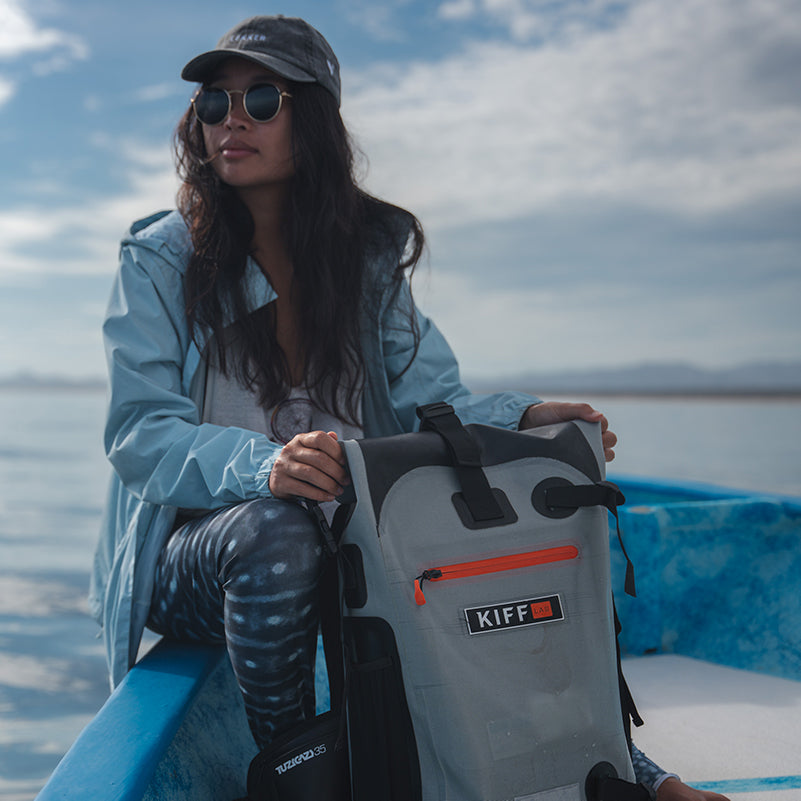
But when a bag is sitting on the floor of a boat in pouring rain with a camera, phone and dry clothes inside, the seam suddenly becomes quite important.
That is the kind of detail we care about at KiffLab.
Not because it gives us another technical term to put on a product page.
Because waterproof gear has one fairly basic job.
Keep the water on the outside.
And to do that properly, it is not enough to choose waterproof fabric.
You have to think about every place where that fabric comes together.
That is why we weld our seams.
Make Adventure Possible.