Waterproof vs Water-Resistant. What IPX Ratings Actually Mean
Waterproof is one of the most overused words in outdoor gear.
A jacket gets called waterproof. A phone case gets called waterproof. A backpack gets called waterproof. Sometimes that means the product can handle a light shower. Sometimes it means it can survive underwater.
Those are very different things.
At KiffLab, we build gear specifically to deal with water, whether that means rain, waves, spray, a wet boat deck or a pack being dropped where it probably should not have been dropped.
So we think it is important to be clear about what terms like waterproof, water-resistant, IPX6 and IPX7 actually mean.
Because when your bag contains a phone, camera, dry clothing or other gear you rely on, the difference matters.
Waterproof and water-resistant are not the same thing
There is no single universal consumer definition that separates every product marketed as "water-resistant" from every product marketed as "waterproof".
That is part of the problem.
Water resistance generally means a product can resist water getting through it under certain conditions. Those conditions could mean a few minutes of rain, splashes from a kayak paddle or something considerably more demanding.
Waterproof should imply a much higher level of protection.
But the word by itself still tells you very little.
The better question is not simply whether something is called waterproof.
The better question is what kind of water exposure it has been designed and rated to withstand.
That is where IP ratings become useful.
What does IPX actually mean?
IP stands for Ingress Protection.
The system comes from IEC 60529, an international standard used to classify how effectively an enclosure protects against solids and water. The standard was originally developed around electrical equipment, but the water test classifications provide a useful objective reference for understanding different levels of water exposure.
A full IP rating often contains two numbers.
The first relates to solid particles such as dust.
The second relates to water.
When you see an X, such as IPX6, it means the rating being communicated is specifically about water rather than making a claim about the solid-particle rating.
And this is where things start getting more useful than simply writing "waterproof" on a product description.
What the different water ratings mean
At the lower end of the scale, the tests deal with dripping and splashing water.
IPX1 covers vertically falling water droplets.
IPX4 covers splashing water from different directions.
IPX5 moves into water jets.
IPX6 covers powerful water jets.
IPX7 changes the test completely and deals with temporary immersion.
IPX8 moves beyond that into immersion under conditions agreed between the manufacturer and testing requirements.

For the type of gear we make at KiffLab, IPX6 and IPX7 are the ratings people are most likely to encounter and misunderstand.
What IPX6 actually means
IPX6 is not a light-rain test.
Under IEC 60529 test conditions, IPX6 involves powerful jets of water directed at the test item.
The test uses a 12.5 mm nozzle with a flow rate of approximately 100 litres of water per minute. Testing is conducted from multiple directions and lasts for at least three minutes.
Put 100 litres per minute into perspective.
A standard bathtub holds somewhere around 150 to 200 litres of water.
The IPX6 flow rate is therefore roughly half a bathtub of water every minute being delivered through a concentrated nozzle.
That is a very different test from standing outside in the rain.
It is designed around significant water exposure.
This is why IPX6 makes sense for gear used around boats, kayaks, paddleboards, beaches, heavy rain and environments where spray can come from multiple directions.
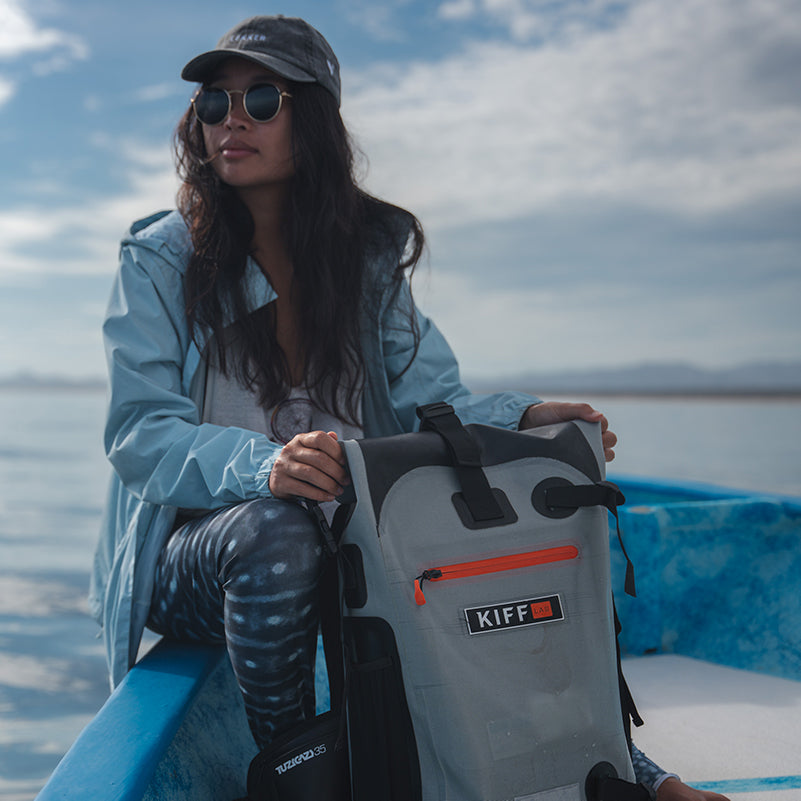
Several of our TuziGazi packs use waterproof TPU construction, high-frequency welded seams and an IPX6 water rating. The Amanzi 20L also carries an IPX6 rating and uses 420D ripstop nylon with a TPU waterproof coating and welded seams.
That combination matters.
The rating is only part of the story.
A waterproof material does not automatically make a waterproof bag
This is an important distinction.
You can start with an excellent waterproof material and still produce a poor waterproof bag.
Every hole, seam, zip and opening creates another potential path for water.
Traditional sewn construction pushes a needle through the material thousands of times. That is not automatically a problem for a conventional backpack, but it becomes much more important when serious water protection is the objective.
This is one reason we use welded construction across products such as the TuziGazi range.
Instead of relying on conventional stitching to join the main waterproof panels, high-frequency welding bonds the material together. That allows the body of the bag to be joined without creating the same rows of needle holes through the waterproof material.
Then there is the closure.
A waterproof bag with an open top is obviously not waterproof.
A roll-top works by folding the opening over itself several times before securing it. On our roll-top products, we recommend at least three rolls before clipping the closure. That creates the seal the rest of the bag depends on.
The practical lesson is simple.
Waterproof performance comes from the entire system.
Material. Seams. Closure. Construction. And how the bag is actually used.
So what about IPX7?
This is where there is a common misunderstanding.
IPX7 means temporary immersion.
A typical IPX7 test places the product in water for 30 minutes at a depth of approximately one metre under the conditions defined by the standard.
That sounds like it must be better than IPX6.
Not necessarily.
IPX6 and IPX7 test two different things.
IPX6 tests powerful moving water.
IPX7 tests temporary immersion in relatively static water.
IEC water ratings above IPX6 are not automatically cumulative. A product that meets an IPX7 immersion test cannot automatically be assumed to have passed the IPX6 powerful jet test as well. Products designed and tested for both conditions can carry ratings showing both.
That distinction matters in the real world.
Imagine two situations.
One bag sits temporarily underwater in calm water.
Another is sitting in an open boat with waves and spray repeatedly hitting it.
Both involve water, but the forces acting on the bag are very different.
The right rating depends on the conditions you expect the product to face.
What an IPX6 bag is built to deal with
For us, the rating needs to relate back to actual use.
An IPX6-rated waterproof pack makes sense when you are dealing with conditions such as heavy rain on a hike, continuous spray on a boat, waves coming over the side of a kayak, wet equipment in the back of a truck, paddleboarding, fishing, beach conditions or a bag sitting on a soaked surface.
That is the environment we think about when developing KiffLab gear.
It does not mean you should deliberately take an IPX6 pack underwater for an hour.
It does not make the bag a diving container.
It does not make every external pocket waterproof.
It also does not remove the need to close the bag correctly.
For extended or deep immersion, the closure design, depth and length of exposure become increasingly important.
We would rather explain that clearly than pretend that one word covers every possible situation.
Waterproof does not mean indestructible
There is another point that ratings cannot completely capture.
Products age.
A brand-new bag and a bag that has spent three years being dragged through sand, salt water, rocks, airport baggage systems and the back of a pickup are not identical.
Abrasion can damage material.
Sand can contaminate closures.
A poorly rolled top can leave a route for water.
Salt should be rinsed away.
A sharp object can puncture even very strong material.
That is why looking after waterproof gear still matters.
After exposure to salt water, sand or mud, we recommend rinsing the bag with fresh water and allowing it to dry completely before storage.
Good gear should be tough.
It should not require you to treat it like glass.
But tough and indestructible are not the same thing.
Why we use TPU
Material choice is another major part of waterproof performance.
Across much of our waterproof range we use TPU, or thermoplastic polyurethane, either as the main waterproof material or as a coating.
Our TuziGazi packs use a heavy 840D TPU material. The Amanzi takes a lighter approach, using 420D ripstop nylon with a TPU waterproof coating.
The reason is practical.
TPU combines waterproof performance with flexibility, abrasion resistance, tear strength and the ability to create strong welded seams. Those properties make it particularly useful when you are trying to build waterproof gear that still needs to bend, roll, carry comfortably and take repeated abuse.
Different products then use different weights and constructions depending on what they are designed to do.
A lighter everyday pack does not need to be built exactly like a heavy-duty paddle pack.
That is product design, not compromise.
What should you actually look for when buying waterproof gear?
Ignore the headline for a moment. Look at the details.
Does the manufacturer explain the water rating? Are the seams welded, taped or simply stitched?
How does the main compartment close? Is the rating for the whole bag or only the material?
Are external pockets protected to the same level as the main compartment?
Is the product intended for rain and spray, temporary immersion or continuous immersion?
Those questions tell you far more than a large "WATERPROOF" logo ever will.
For valuable electronics, we also believe in sensible redundancy. If you are heading into an environment where losing a camera, phone, medication or communication device would create a serious problem, protect it accordingly.
Even excellent gear can be damaged.

Our view at KiffLab
We started KiffLab around people who actually spend time outside.
Surfing. Paddling. Boating. Fishing. Camping. Travelling.
Getting wet was never a hypothetical part of the product brief.
That is why we care about waterproof materials, welded seams, roll-top closures and meaningful ratings.
But it is also why we do not think "waterproof" should be treated as a magic word.
A good piece of outdoor equipment should tell you what it was designed to handle.
IPX6 means something.
IPX7 means something different.
The material matters. The construction matters. And how you use the gear matters.
Our job is to build products that perform when conditions get wet and messy, then give you enough information to choose the right product for where you are going.
Because the point of waterproof gear is not the rating printed on the page.
It is getting to the end of the day and finding the things inside your bag exactly as you left them.
Dry. Protected. Ready for whatever comes next.
Make Adventure Possible.