Why Roll-Top Closures Work

A roll-top closure looks almost too simple.
There is no complicated locking mechanism. No waterproof zipper running across the full opening. No valve or screw cap.
You put your gear inside, push out excess air, fold the opening over itself several times and clip it closed.
Yet that simple design has become one of the most widely used closure systems for dry bags, waterproof backpacks, bikepacking bags and marine gear.
There is a good reason for that.
When it is designed properly and closed correctly, a roll-top gives water a difficult path into the bag while avoiding one of the biggest potential weak points in waterproof gear, a large opening that relies on a conventional zipper.
At KiffLab, we use roll-top systems across much of our waterproof range because they are simple, reliable and suited to the environments our gear is designed for.
But the important part is understanding how they actually work.
The opening is usually the hardest part to waterproof
Making a waterproof sheet of material is relatively straightforward.
Making an entire bag waterproof is harder.
A bag needs seams. It needs an opening. It may need straps, attachment points, pockets and other components.
Every time you cut, stitch or open waterproof material, you create another possible route for water.
That is why waterproof construction is a system rather than a single feature.
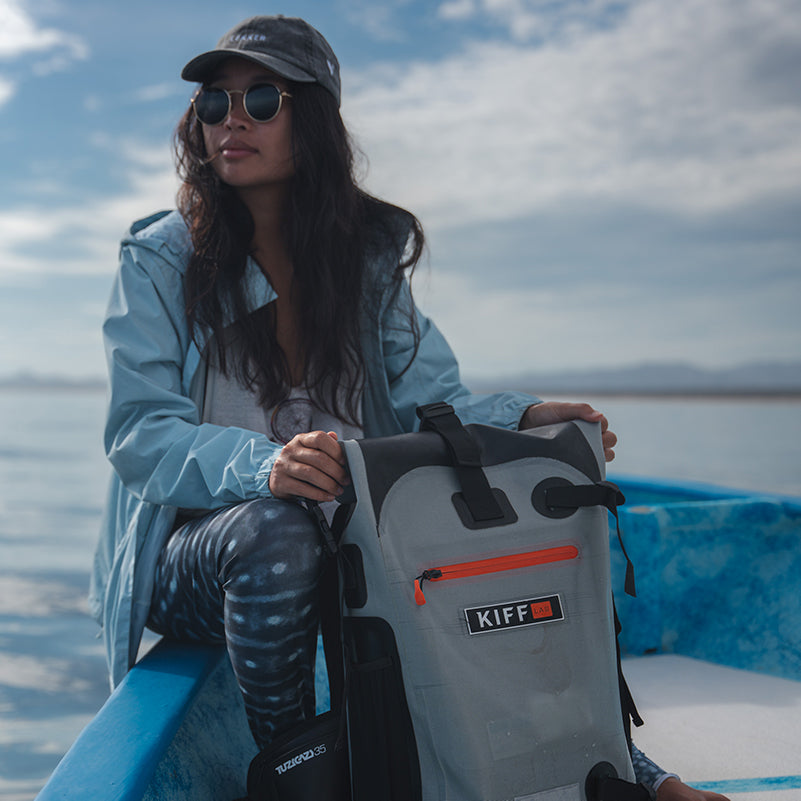
On our TuziGazi packs, for example, the main body uses 840D TPU material, high-frequency welded seams and a roll-top closure. Our Amanzi uses TPU-coated 420D ripstop nylon, welded seams and a roll-top closure with compression buckles.
The waterproof material stops water passing through the body.
The welded seams reduce the need for needle holes through the waterproof panels.
Then the roll-top deals with the biggest opening in the bag.
All three parts need to work together.
What happens when you roll the top
Imagine leaving the top of a dry bag open.
Water has a straight path inside.
Fold the opening over once and that path changes direction.
Fold it again and it has to travel around another layer.
Fold it a third time and the opening is now wrapped inside several overlapping layers of waterproof material.
The buckle then holds those folds under tension so that the closure stays compressed rather than unfolding as the bag moves.
It is a very simple mechanical idea.
Instead of trying to block water with one single barrier, you create a longer and more difficult route for it to travel.
That is why the number of rolls matters.

Three rolls is not an arbitrary rule
Most experienced dry bag users will have heard the same advice.
Roll the top at least three times.
That advice is not just outdoor folklore.
Sea to Summit instructs users of several of its dry bags to roll the closure three times. Its product specifications even measure the finished height of its bags with the top rolled three times.
ORTLIEB goes further. For a number of its waterproof roll-top products, the company specifies that the closure must be rolled three to four times to achieve its stated IP64 level of protection.
That is useful evidence because it shows that closure technique is part of waterproof performance.
The material does not change when you roll the bag twice instead of three times.
The seams do not change.
What changes is the closure.
At KiffLab, our practical rule is simple.
Use at least three firm rolls before securing the closure.
If there is not enough material left at the top to achieve those rolls properly, the bag is probably overpacked.
Why overpacking matters
Roll-top bags need space above the contents.
That space is part of the closure system.
Stuff a pack right to the top and you reduce the amount of material available to create the folds.
Instead of three tight, even rolls, you may end up with one or two loose folds sitting on top of your gear.
That is not the same closure.
This is also why a 20 litre roll-top bag does not behave exactly like a rigid 20 litre container.
Part of its total material height needs to remain available for sealing.
Our TuziGazi 20, for example, measures approximately 60 cm high when completely unrolled and around 42 cm once rolled down. The usable shape changes as the closure is formed.
That adjustability is actually one of the advantages of a roll-top.
Carry less gear and you can roll the bag farther down.
Carry more and you can use more of the available height, provided you still leave enough material to close it properly.
The roll also helps control air
Anyone who has closed a dry bag has probably experienced this.
Roll the top without removing the air and the bag turns into a balloon.
Push some air out first and the entire pack becomes smaller and more stable.
That matters for more than convenience.
Reducing excess air makes the bag easier to compress and easier to secure. It also prevents a large pocket of trapped air pushing back against the closure.
Some trapped air can be useful.
Our TuziGazi packs can float when they are properly sealed with an air pocket inside.
But there is a difference between deliberately leaving some buoyancy and trying to close a completely inflated bag.
The closure should not feel as though the contents are trying to force it open.

Why not just use a zipper?
Zippers are convenient.
That is why we use them where quick access makes sense.
But there is a major difference between a normal zipper, a water-resistant zipper and a genuinely watertight zipper.
They are not interchangeable.
YKK, one of the world's largest zipper manufacturers, produces specialist waterproof systems such as AQUASEAL. These require specific construction, installation and maintenance. YKK advises users to keep the zipper clean, avoid forcing the slider and perform maintenance to preserve waterproof performance. Some AQUASEAL products are individually pressure tested for leakage.
That technology works extremely well when it is required.
It also shows how much engineering goes into making a zipper genuinely resistant to water.
For many outdoor bags, a roll-top provides a simpler solution.
There are fewer moving parts.
There is no long zipper track across the main opening.
Sand cannot jam a row of zipper teeth.
There is no slider that needs to travel perfectly along the entire opening every time the bag is closed.
That simplicity suits the kind of gear we build.
But a roll-top is not automatically submersible
This distinction is important.
A good roll-top closure is extremely effective against rain, spray and water coming over a boat or kayak.
That does not mean every roll-top dry bag should be treated as an underwater container.
Sea to Summit makes this distinction clearly. Its Lightweight Dry Bag uses waterproof fabric with a 10,000 mm hydrostatic head rating, yet the company still advises against submerging the bag because water can enter through a roll-top closure.
ORTLIEB gives similar guidance on several IP64 roll-top products. They are designed to protect against splashing water from all directions, but the company states that water may enter if the product is completely submerged.
This comes back to something we believe strongly at KiffLab.
Use the right product for the right conditions.
Waterproof does not mean indestructible, and it does not mean every waterproof product is designed for the same type of water exposure.
Our IPX6-rated TuziGazi packs are designed around serious rain, spray and powerful water exposure. IPX6 itself tests powerful water jets. It is different from IPX7, which tests temporary immersion.
That difference matters.
What can cause a roll-top to fail?
The design is simple, but it still needs to be used correctly.
The most common problems are equally simple.
Not enough rolls
One loose fold is not the same as three firm rolls.
Overpacking
If the contents reach right to the opening, there may not be enough material left to build the closure properly.
Something caught in the opening
A strap, piece of clothing, cord or other object running through the rolled section can create a path for water.
Uneven rolling
The two sides should be reasonably aligned. A badly twisted closure is harder to compress evenly.
Damaged material
A waterproof closure cannot compensate for a puncture or abrasion elsewhere in the bag.
Assuming every pocket is waterproof
On many outdoor products, external convenience pockets are designed for quick access and may only be water-resistant. On our TuziGazi range, for example, the front zipped pocket is described separately from the waterproof main compartment.
The main compartment is where you put the gear that absolutely needs protection.
How we recommend closing a KiffLab roll-top
There is no complicated technique.
Pack the bag without filling it all the way to the opening.
Bring the two sides of the top together.
Push out excess air if you want the pack compressed.
Make the first firm roll.
Keep the roll straight and continue for at least three complete turns.
Secure the buckles or side compression system.
Check that nothing has been caught inside the rolled section.
That takes a few seconds.
It also makes the difference between owning waterproof gear and actually using it properly.
Why we keep coming back to simple design
Outdoor equipment has a habit of becoming complicated.
More compartments.
More fasteners.
More mechanisms.
More features to put on the specification sheet.
Sometimes those things genuinely improve a product.
Sometimes the simplest solution is still the best one.
The roll-top is a good example.
It creates an adjustable opening.
It helps compress the load.
It works with waterproof welded construction.
It has very few components to fail.
It can be opened and closed with cold or wet hands.
And when it gets covered in mud, sand or salt water, there is not much there to go wrong.
That matters to us.
KiffLab gear is built to be used.
Thrown into boats.
Carried down beaches.
Taken camping.
Strapped into vehicles.
Used in rain.
Covered in sand.
Packed for flights.
Dragged through places where protecting your gear matters far more than keeping your backpack looking pristine.
The roll-top fits that philosophy.
Simple. Functional. Proven.
Make Adventure Possible.